Operational dashboards
Requests, statuses and activity views that help the team identify what needs to happen next.
IGTCODE Services Serbia
IGTCODE is a software development company in Serbia building dashboards and business analytics for companies and organisations. We connect databases, APIs and operational data into views that help teams understand their business.
A good dashboard answers a specific business question. For each KPI, we define its source, calculation, reporting period and audience. This avoids different teams interpreting the same indicator differently.
We develop business intelligence-style systems around real processes, paying attention to data quality and availability.
Requests, statuses and activity views that help the team identify what needs to happen next.
Managers, coordinators and operational users receive views matching their permissions and responsibilities.
Reports triggered by a schedule or business event, with agreed formats, recipients and access controls.
We connect multiple sources and reconcile identifiers, dates and field meanings. We check missing values, duplicates and differences between operational and aggregate data. Refresh frequency reflects business needs and service limitations.
A report should show its reporting period and data freshness. Calculations are tested against known examples. We track source-system changes so a new data format does not silently change a metric's meaning.
We choose technology around the requirements and existing system. The specific stack and each service's role are agreed during planning.
Define users, KPIs and the decisions to support.
Check data, available APIs and refresh frequency.
Develop aggregation, filters, reports and user views.
Compare results with known data and introduce monitoring.
Not necessarily. A dashboard inside an existing app is often enough for a clearly defined process. The choice depends on sources, scale and user needs.
Yes, after checking access and data quality. Agreeing what data means before aggregating it is essential.
Yes. Reports can follow a schedule or an event, with agreed distribution and access rules.
Yes. Views and data access follow user roles, with the backend checking which information each user may receive.
Not always. Daily updates are sufficient for some processes. We choose more frequent refreshes when their business value justifies the cost and complexity.
We identify missing values, duplicates and conflicting formats first. Cleaning data and defining input rules are often necessary before reports can be reliable.
In practice
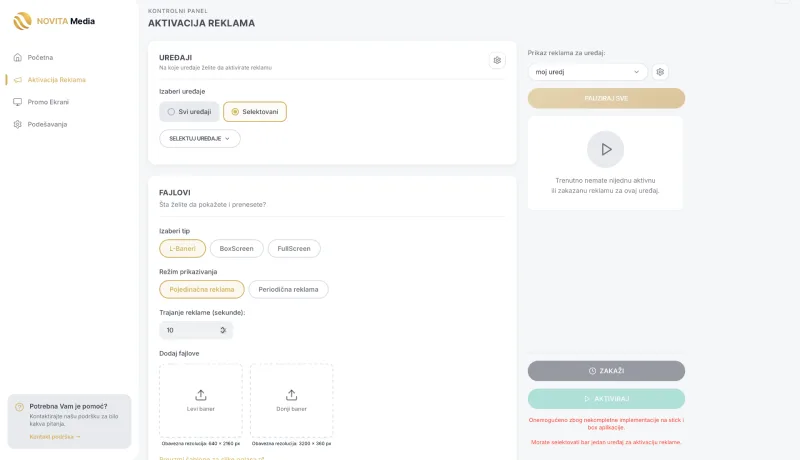
Digital signage and advertising platform
Central management of campaigns, devices and multimedia content on digital screens.
Next step
Tell us what it needs to do, who will use it and what matters most to you. Together, we will clarify the scope and propose the next step.